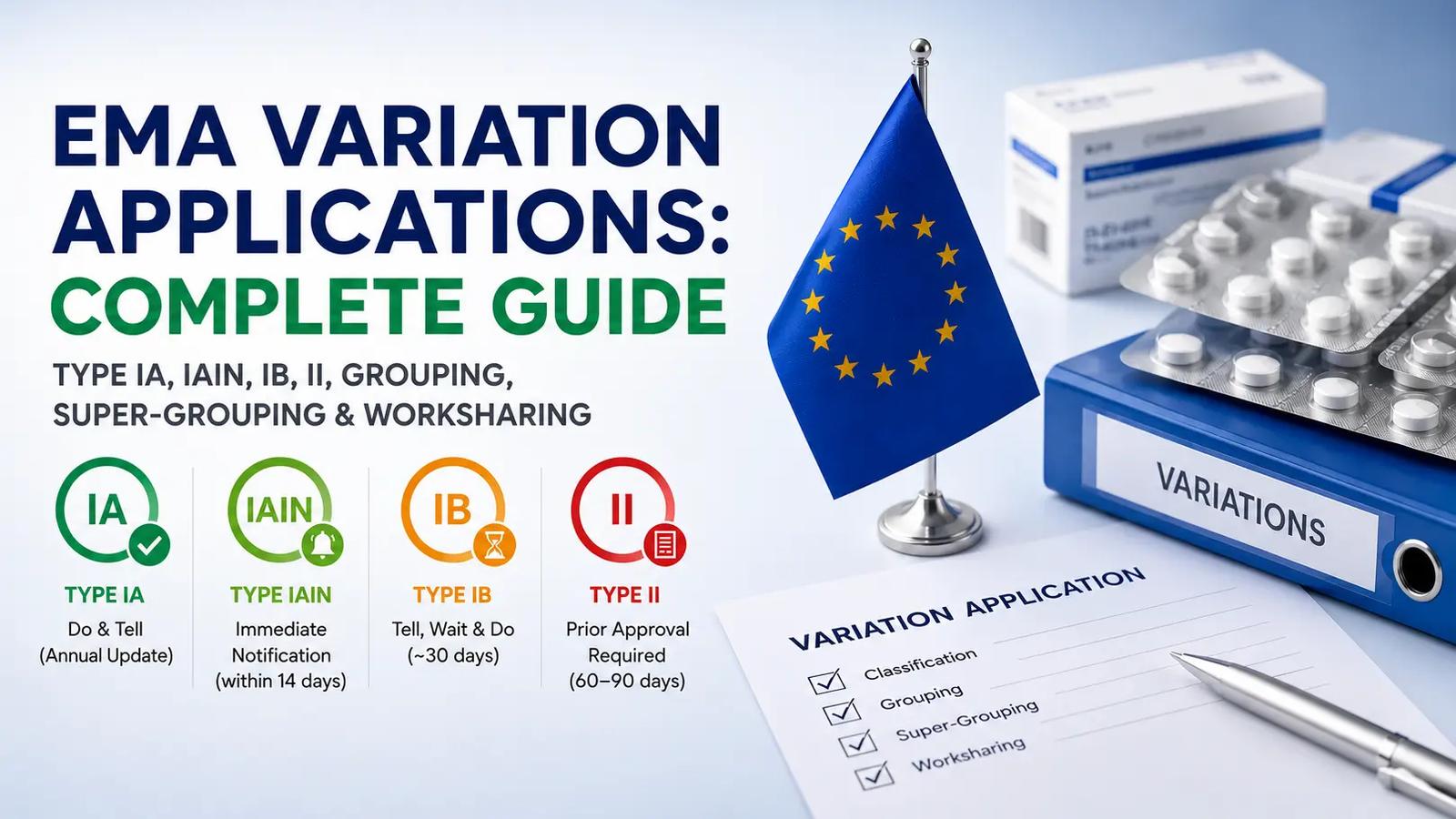
Introduction
Post-approval changes are a normal part of the pharmaceutical product lifecycle. In the European Union, these changes must be managed through structured variation procedures to ensure that product quality, safety, and efficacy remain unaffected.
The European Medicines Agency continues to strengthen a risk-based, efficient, and digital lifecycle management system, with greater emphasis on:
- Accurate classification (IA / IAIN / IB / II)
- Optimized grouping strategies
- Expanded super-grouping
- Mandatory/structured work-sharing
- Digital submissions via IRIS
What is a Variation?
A variation is any change to the terms of an approved Marketing Authorization (MA).
Examples include:
- Manufacturing site changes
- Specification updates
- Process improvements
- Labelling or safety updates
Every change must be:
- Classified correctly
- Scientifically justified
- Submitted/implemented as per regulatory requirements
Classification of Variations (Critical Section)
1. Type IA (Minor Variation - Annual Update – “Do & Tell”)
These are minimal risk changes.
Key features:
- Can be implemented
- Notified to authorities 9 to 12 months cycle – Annual update
Type IAIN (Minor Variation Immediate Notification (not annual reporting)
Key features:
- Can be implemented immediately
- Immediate notification required (within 14 days of implementation)
Type IA vs Type IAIN
Category Description
Type IA: Standard minor change (annual notification allowed)
Type IAIN: Immediate notification required (within 14 days of implementation)
2. Type IB (Minor Variation – “Tell, Wait & Do”)
Moderate impact changes Cannot be implemented until:
- Authority review is completed
- Or no objection within 30 days
3. Type II (Major Variation – “Prior Approval required”)
High-impact changes affecting:
- Quality
- Safety
- Efficacy
Requires full regulatory approval before implementation
Grouping of Variations
Grouping allows multiple changes to be submitted in one application.
Types of Grouping:
- Standard Grouping: Related changes for one product
- Annex III Grouping: Pre-approved combinations defined by regulation
- Custom Grouping (Article 7.2(c)): Requires justification and regulatory acceptance
- Super-Grouping :Super-grouping is designed to improve efficiency for repetitive changes.
What is Allowed:
- Multiple Type IA / IAIN variations
- Across multiple products
- Single submission
Conditions:
- Same MAH
- Same type of change
- Same justification
Benefit:
- Major reduction in regulatory workload
Work-sharing Procedure
Work-sharing applies to same variation (IB or II) across multiple products
Key Features:
- Single assessment for multiple MAs
- One authority acts as reference
- Applicable across EU
Mandatory Cases:
- Multi-product IB variations
- Consistency-driven changes
Variation Application Process
- Change identification
- Classification (IA / IAIN / IB / II)
- Strategy (grouping / work-sharing / standalone)
- Dossier preparation
- Submission via IRIS
- Validation
- Assessment
- Approval / notification
Documentation Requirements
Typical submission includes:
- Electronic Application Form (eAF)
- Cover letter (with grouping/work-sharing justification)
- Updated CTD sections
- Supporting data (CMC / clinical / non-clinical)
- Risk assessment
For grouping:
- Clearly define highest variation category
- Provide scientific rationale
Regulatory Timelines

Key Challenges in Practice
- Incorrect Classification: Most common issue → Leads to rejection or reclassification
- Misuse of Grouping: Unrelated changes grouped together → Regulatory objections
- Super-Grouping Misapplication: Attempting IB/II under super-grouping → Not allowed
- Work-sharing Complexity: Multi-product coordination issues → Data alignment challenges
- Documentation Gaps: Missing CMC data → Poor justification
Future Trends in EU Variations
- Full digital lifecycle management
- Integration with Product Lifecycle Management (PLCM)
- Increased automation
- Greater reliance on global harmonization (ICH)
- Faster handling of low-risk variations
How RegOrbis Pharma Supports You
At RegOrbis Pharma, we provide:
- Accurate variation classification (IA / IAIN / IB / II)
- Strategic planning for grouping & work-sharing
- Super-grouping optimization
- Complete dossier preparation
- Query handling & lifecycle support
Ensuring your variations are → compliant, efficient, and approval-ready
Conclusion
With the current EMA variation framework, lifecycle management has become more structured, efficient, and strategically driven.
By applying:
- Correct classification
- Smart grouping
- Effective work sharing
Companies can:
- Reduce regulatory burden
- Avoid delays
- Maintain continuous compliance
At RegOrbis Pharma, we help you manage post-approval changes with precision—ensuring every variation is strategically planned, scientifically justified, and globally compliant.
If you need expert support for Variation Application, our regulatory experts are ready to assist
📧 Email: Info@regorbispharma.com
📱 Phone: +91 9967265308 / 9668430491
🌐 Website: www.regorbispharma.com