Introduction
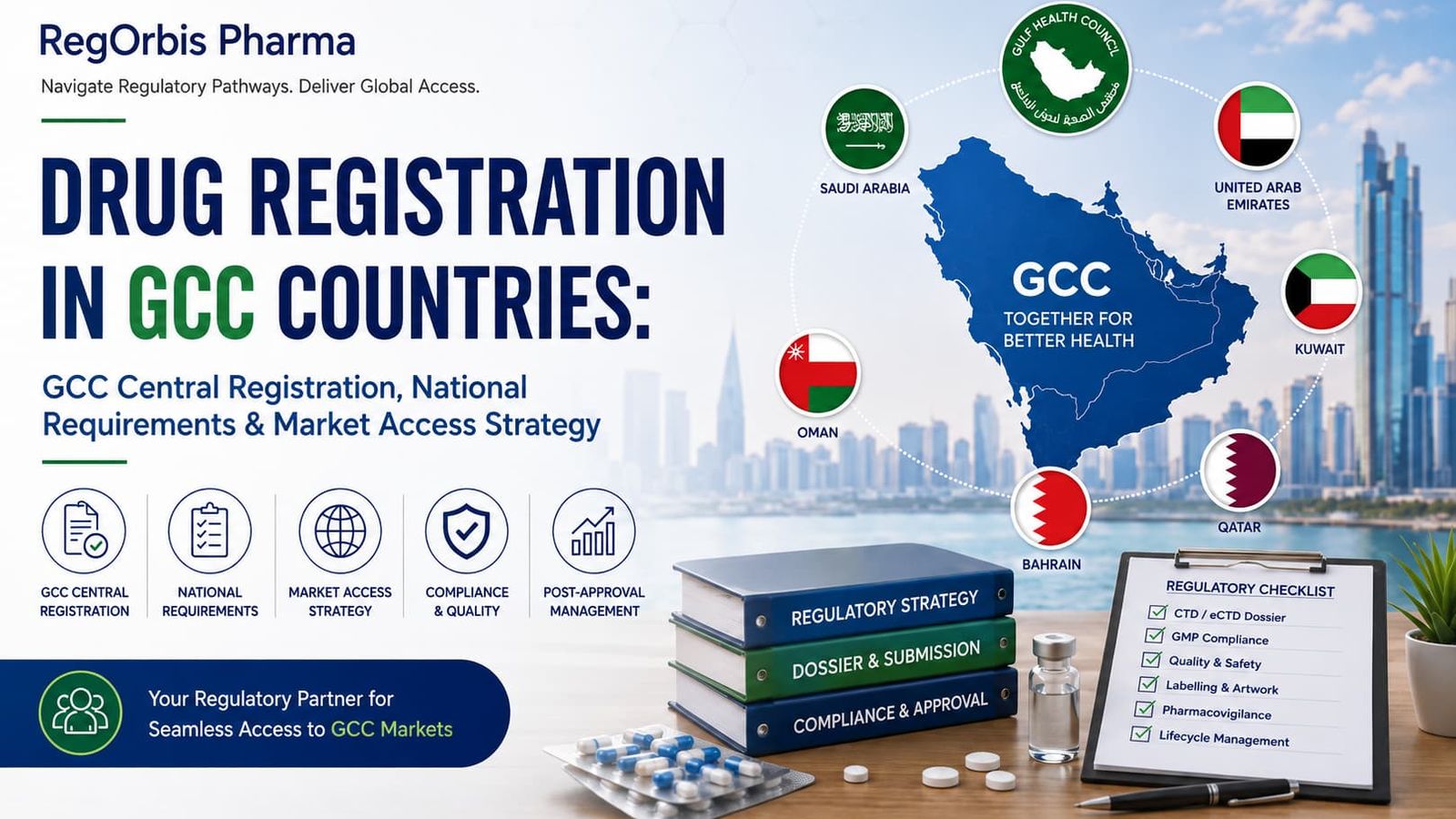
The Gulf Cooperation Council (GCC) region is an increasingly important market for pharmaceutical companies seeking to expand their international footprint. The GCC comprises Saudi Arabia, United Arab Emirates, Kuwait, Qatar, Bahrain, and Oman, representing a strategically important pharmaceutical and healthcare market.
For companies planning to introduce pharmaceutical products in the region, understanding the regulatory landscape is essential. The GCC has established a Central Drug Registration system through the Gulf Health Council (GHC) to promote harmonization and coordination in pharmaceutical registration across the GCC Member States.
However, GCC Central Drug Registration should not be viewed as a complete replacement for national regulatory requirements. Companies must carefully evaluate the applicable central pathway together with country-specific regulatory, licensing, pricing, labelling, local representation, importation and post-approval requirements. This distinction is critical when developing a GCC market-entry strategy.
Understanding GCC Central Drug Registration
The Gulf Health Council operates a unified Central Drug Registration system for pharmaceutical products and companies. The program aims to:
- Harmonize systems and procedures for pharmaceutical registration
- Standardize information and requirements for medicine registration
- Support registration of pharmaceutical companies and products
- Promote implementation of Good Manufacturing Practices (GMP)
- Strengthen coordination among GCC Member States
- Support pharmaceutical quality, safety and efficacy
- Coordinate pharmaceutical pricing initiatives
- Support post-marketing follow-up related to product quality and adverse effects
The Central Gulf Committee for Drug Registration is responsible for central drug registration activities and includes representatives from the GCC Member States.
The GCC framework has also continued to evolve. In 2026, the Gulf Health Council announced additional centralized registration pathways for orphan drugs and breakthrough drugs, reflecting efforts to support innovative therapies and improve access to advanced treatments in the GCC region.
The Six GCC Pharmaceutical Markets
- Saudi Arabia: Saudi Food and Drug Authority (SFDA)
- United Arab Emirates: Ministry of Health and Prevention (MOHAP)
- Kuwait: Ministry of Health
- Qatar: Ministry of Public Health (MoPH)
- Bahrain: National Health Regulatory Authority (NHRA)
- Oman: Ministry of Health
Although regulatory harmonization is an important GCC objective, pharmaceutical companies should not assume that one registration automatically eliminates all country-level obligations. A successful market-entry strategy therefore requires assessment of both the GCC Central Registration pathway and the applicable national regulatory requirements.
GCC Central Registration vs. National Requirement Introduction
The Gulf Cooperation Council (GCC) region is an increasingly important market for pharmaceutical companies seeking to expand their international footprint. The GCC comprises Saudi Arabia, United Arab Emirates, Kuwait, Qatar, Bahrain, and Oman, representing a strategically important pharmaceutical and healthcare market.
For companies planning to introduce pharmaceutical products in the region, understanding the regulatory landscape is essential. The GCC has established a Central Drug Registration system through the Gulf Health Council (GHC) to promote harmonization and coordination in pharmaceutical registration across the GCC Member States.
However, GCC Central Drug Registration should not be viewed as a complete replacement for national regulatory requirements. Companies must carefully evaluate the applicable central pathway together with country-specific regulatory, licensing, pricing, labelling, local representation, importation and post-approval requirements. This distinction is critical when developing a GCC market-entry strategy.
Understanding GCC Central Drug Registration
The Gulf Health Council operates a unified Central Drug Registration system for pharmaceutical products and companies. The program aims to:
- Harmonize systems and procedures for pharmaceutical registration
- Standardize information and requirements for medicine registration
- Support registration of pharmaceutical companies and products
- Promote implementation of Good Manufacturing Practices (GMP)
- Strengthen coordination among GCC Member States
- Support pharmaceutical quality, safety and efficacy
- Coordinate pharmaceutical pricing initiatives
- Support post-marketing follow-up related to product quality and adverse effects
The Central Gulf Committee for Drug Registration is responsible for central drug registration activities and includes representatives from the GCC Member States.
The GCC framework has also continued to evolve. In 2026, the Gulf Health Council announced additional centralized registration pathways for orphan drugs and breakthrough drugs, reflecting efforts to support innovative therapies and improve access to advanced treatments in the GCC region.
The Six GCC Pharmaceutical Markets
- Saudi Arabia: Saudi Food and Drug Authority (SFDA)
- United Arab Emirates: Ministry of Health and Prevention (MOHAP)
- Kuwait: Ministry of Health
- Qatar: Ministry of Public Health (MoPH)
- Bahrain: National Health Regulatory Authority (NHRA)
- Oman: Ministry of Health
Although regulatory harmonization is an important GCC objective, pharmaceutical companies should not assume that one registration automatically eliminates all country-level obligations. A successful market-entry strategy therefore requires assessment of both the GCC Central Registration pathway and the applicable national regulatory requirements.
GCC Central Registration vs. National Requirements
The Gulf Cooperation Council (GCC) region is an increasingly important market for pharmaceutical companies seeking to expand their international footprint. The GCC comprises Saudi Arabia, United Arab Emirates, Kuwait, Qatar, Bahrain, and Oman, representing a strategically important pharmaceutical and healthcare market.
For companies planning to introduce pharmaceutical products in the region, understanding the regulatory landscape is essential. The GCC has established a Central Drug Registration system through the Gulf Health Council (GHC) to promote harmonization and coordination in pharmaceutical registration across the GCC Member States.
However, GCC Central Drug Registration should not be viewed as a complete replacement for national regulatory requirements. Companies must carefully evaluate the applicable central pathway together with country-specific regulatory, licensing, pricing, labelling, local representation, importation and post-approval requirements. This distinction is critical when developing a GCC market-entry strategy.
Understanding GCC Central Drug Registration
The Gulf Health Council operates a unified Central Drug Registration system for pharmaceutical products and companies. The program aims to:
- Harmonize systems and procedures for pharmaceutical registration
- Standardize information and requirements for medicine registration
- Support registration of pharmaceutical companies and products
- Promote implementation of Good Manufacturing Practices (GMP)
- Strengthen coordination among GCC Member States
- Support pharmaceutical quality, safety and efficacy
- Coordinate pharmaceutical pricing initiatives
- Support post-marketing follow-up related to product quality and adverse effects
The Central Gulf Committee for Drug Registration is responsible for central drug registration activities and includes representatives from the GCC Member States.
The GCC framework has also continued to evolve. In 2026, the Gulf Health Council announced additional centralized registration pathways for orphan drugs and breakthrough drugs, reflecting efforts to support innovative therapies and improve access to advanced treatments in the GCC region.
The Six GCC Pharmaceutical Markets
- Saudi Arabia: Saudi Food and Drug Authority (SFDA)
- United Arab Emirates: Ministry of Health and Prevention (MOHAP)
- Kuwait: Ministry of Health
- Qatar: Ministry of Public Health (MoPH)
- Bahrain: National Health Regulatory Authority (NHRA)
- Oman: Ministry of Health
Although regulatory harmonization is an important GCC objective, pharmaceutical companies should not assume that one registration automatically eliminates all country-level obligations. A successful market-entry strategy therefore requires assessment of both the GCC Central Registration pathway and the applicable national regulatory requirements.
GCC Central Registration vs. National Rets
One of the most important considerations for companies entering the GCC is understanding the relationship between centralized and national regulatory processes.
GCC Central Drug Registration
The central framework is intended to create greater consistency and coordination in pharmaceutical registration across GCC countries. It provides a regional mechanism for:
Pharmaceutical company registration
- Product registration
- Technical evaluation
- GMP-related activities
- Regulatory coordination
- Pharmaceutical information standardization
- Post-marketing regulatory follow-up
The Gulf Health Council states that the central registration program is designed to unify registration systems and procedures and increase integration among GCC Member States.
National Regulatory Requirements
At the same time, pharmaceutical companies must consider the requirements of individual national authorities. Depending on the target country and product, these may include:
Local company or agent requirements
- National licensing
- Product-specific requirements
- Pricing requirements
- Labelling and artwork requirements
- Importation requirements
- Pharmacovigilance obligations
- Local post-approval requirements
- National variations and renewals
- Country-specific administrative documentation
Therefore, GCC Central Registration and national regulatory requirements should be considered as interconnected components of the overall market-access strategy rather than as mutually exclusive concepts.
Why a GCC Regulatory Strategy Is Important
A company planning to enter the GCC pharmaceutical market should establish its regulatory strategy before beginning dossier preparation. A well-designed strategy can help determine:
1. Which GCC markets should be prioritized?
The company should evaluate commercial objectives, product demand, competitive environment, local requirements and launch plans.
2. Which registration pathway is appropriate?
The regulatory team should assess whether the product is eligible for and best suited to a centralized GCC pathway or whether national regulatory pathways should also be pursued.
3. What dossier adaptations are required?
An existing CTD/eCTD dossier may require regional or country-specific adaptations.
4. What manufacturing documentation is required?
GMP certificates, manufacturing licenses, Site Master File information and other manufacturing documentation should be assessed early.
5. What local representation is required?
Local agent or representative requirements can be an important part of the regulatory and commercial strategy.
6. What post-approval commitments should be planned?
Regulatory obligations continue after approval and should be incorporated into the product lifecycle plan.
Key Components of GCC Drug Registration
1. Pharmaceutical Company Documentation
Depending on the applicable pathway, documentation may include:
- Marketing Authorization Holder information
- Manufacturing licenses
- GMP certificates
- Legal documents
- Certificates issued by competent authorities
- Authorization letters
- Local representative/agent documentation
- All documents should be reviewed for validity, consistency, authentication and applicable legalization requirements.
2. Pharmaceutical Product Dossier
A robust technical dossier is fundamental to successful regulatory submission. The dossier may include:
Administrative Documentation
- Application forms
- Company information
- Product information
- Legal documentation
- Manufacturing-site documentation
- Labelling and artwork
Quality / CMC Documentation
Active pharmaceutical ingredient information
- Drug product information
- Manufacturing process
- Process controls
- Specifications
- Analytical methods
- Analytical validation
- Process validation
- Batch analysis
- Stability data
- Container closure system
Non-Clinical Documentation
- Pharmacology
- Pharmacokinetics
- Toxicology
- Supporting non-clinical data
Clinical Documentation
- Clinical study reports
- Bioequivalence data
- Biopharmaceutic information
- Clinical summaries
- Safety and efficacy information
A regulatory gap assessment should be performed before submission to identify missing or inconsistent information.
GMP and Manufacturing-Site Compliance
Manufacturing-site compliance is a critical element of pharmaceutical registration. Companies should evaluate:
- GMP certification status
- Manufacturing license
- Site Master File
- Manufacturing-site information
- Inspection history
- Quality systems
- Supporting certificates and regulatory documentation
The GCC Central Drug Registration framework includes inspection of pharmaceutical manufacturing facilities to verify implementation of GMP principles. Early manufacturing-site readiness assessment can therefore help identify potential regulatory risks before submission.
Labelling, Artwork and Product Information
Regulatory compliance does not end with technical dossier preparation. Product information and artwork may require careful assessment of:
- Product name
- Active ingredient
- Strength
- Dosage form
- Indications
- Posology
- Warnings and precautions
- Contraindications
- Storage conditions
- Pack size
- Manufacturer information
- Marketing Authorization Holder information
- Package leaflet
- Language requirements
- Country-specific requirements
A company should avoid assuming that artwork approved in another international market will automatically meet GCC requirements. A dedicated GCC labelling and artwork gap assessment can help identify country-specific differences before submission
Pricing Considerations
Pharmaceutical pricing is also an important part of GCC market access. The Gulf Health Council maintains a dedicated pharmaceutical pricing framework and committee that addresses pricing and repricing activities and supports coordination of pharmaceutical pricing across GCC countries. Therefore, pricing requirements should be considered alongside regulatory planning rather than treated as an entirely separate activity.
Local Representation and Regulatory Coordination
Depending on the applicable country and pathway, companies may need to work with local representatives, agents or licensed entities. Effective coordination between:
MAH / Manufacturer → Regulatory Consultant → Local Partner / Agent → GCC / National Authority
Can help improve submission readiness and regulatory communication. The regulatory responsibilities of the local partner should be clearly defined at the beginning of the project.
Post-Approval Regulatory Management
Regulatory responsibility continues after marketing authorization. Companies may need ongoing support for:
- Renewals
- Variations
- Manufacturing-site changes
- Product information updates
- Labelling changes
- Safety-related updates
- Pharmacovigilance
- Regulatory commitments
- Product complaints
- Recalls
- Regulatory intelligence
- Lifecycle management
The GCC Central Drug Registration program includes post-marketing follow-up related to product quality and adverse effects, demonstrating the importance of continued regulatory oversight after approval.
Common Regulatory Challenges in GCC Market Entry: Pharmaceutical companies may encounter several challenges when planning GCC registration.
Dossier Gaps: Existing dossiers may not fully address GCC or national requirements.
CMC Deficiencies: Incomplete manufacturing, analytical, validation or stability documentation may lead to regulatory questions.
GMP Documentation: Expired, inconsistent or incomplete GMP documentation can create submission and compliance issues.
Country-Specific Requirements: Different national implementation requirements can complicate a multi-country launch strategy.
Labelling and Artwork: Country-specific product information and packaging requirements may require additional regulatory review.
Local Representation; Selecting and coordinating with an appropriate local partner can be critical.
Pricing: Pricing requirements should be evaluated early as part of the market-access strategy.
Post-Approval Management: Companies need a structured system for maintaining registrations and managing regulatory changes after approval.
Recommended GCC Market-Entry Approach
A structured regulatory approach can be organized into the following stages:
1. Product & Regulatory Classification: Determine the product category and applicable regulatory framework.
2. GCC Market Assessment: Identify priority GCC countries based on commercial and regulatory objectives.
3. Registration Pathway Assessment: Evaluate GCC Central Registration and applicable national pathways.
4. Regulatory Gap Assessment: Compare the existing dossier against applicable GCC and country-specific requirements.
5. Manufacturing & GMP Readiness: Review manufacturing-site documentation and GMP compliance.
6. Dossier Preparation: Prepare or adapt the CTD/eCTD dossier and supporting documents.
7. Labelling & Artwork Review: Ensure product information and packaging comply with applicable requirements.
8. Submission & Regulatory Interaction: Manage submission, validation, authority queries and deficiency responses.
9. Approval & Market Launch: Coordinate regulatory approval with pricing, local representation and commercial readiness.
10. Post-Approval Lifecycle Management: Manage renewals, variations, safety updates, regulatory commitments and ongoing compliance.
How RegOrbis Pharma Can Support GCC Market Entry
RegOrbis Pharma supports pharmaceutical and life-science companies with regulatory activities associated with GCC and international market expansion. Our regulatory capabilities include:
Regulatory Strategy & Pathway Assessment
- GCC Market Entry Strategy
- Marketing Authorization Support
- CTD/eCTD Dossier Preparation & Management
- CMC Regulatory Support
- Regulatory Medical Writing
- Regulatory Gap Assessment
- Compliance Assessment
- GMP & Manufacturing-Site Documentation Support
- Labelling & Artwork Compliance
- Regulatory Submission Support
- Regulatory Query Management
- Post-Approval Lifecycle Management
- Regulatory Intelligence
Our approach is designed to help pharmaceutical companies understand regulatory expectations, identify potential gaps early, improve submission readiness and establish a practical pathway for GCC market expansion.
For companies planning pharmaceutical market entry into the GCC:
- GCC Central Drug Registration provides a harmonized regional framework for pharmaceutical registration.
- The Gulf Health Council continues to develop and update the GCC regulatory framework.
- Central registration should not be assumed to eliminate all national regulatory requirements.
- Country-specific regulatory, pricing, labelling, local representation and post-approval requirements should be assessed.
- A strong CTD/eCTD and CMC package is essential for regulatory readiness.
- GMP and manufacturing-site compliance should be evaluated early.
- Regulatory strategy should be aligned with the company's commercial market-entry plan.
- Post-approval lifecycle management is an integral part of GCC market access.
Conclusion
The GCC pharmaceutical market offers significant opportunities for companies seeking to expand into the Middle East. However, successful market access requires a clear understanding of the relationship between GCC Central Drug Registration and country-specific regulatory requirements.
The GCC Health Council's centralized registration framework promotes harmonization, coordination and standardization of pharmaceutical registration processes across the Member States. At the same time, companies should carefully assess the applicable national requirements and implementation procedures for each target market.
A well-planned regulatory strategy—covering registration pathway selection, dossier readiness, CMC, GMP, labelling, local representation, pricing and post-approval lifecycle management—can help companies navigate GCC market entry more efficiently.
Need Regulatory Support for GCC Market Entry?
RegOrbis Pharma can support your organization with regulatory strategy, dossier management, product registration, CMC support, compliance, post-approval activities and international market expansion. Explore how we can support your GCC regulatory strategy.
📧 Email: Info@regorbispharma.com
📱 Phone: +91 9967265308 / 9668430491
🌐 Website: www.regorbispharma.com