Introduction
In today's global pharmaceutical industry, regulatory submissions are no longer limited to preparing high-quality scientific and clinical data. The way regulatory information is organized, structured, published, and submitted is equally important for successful regulatory review.
Different regulatory authorities and regions may follow different submission structures and electronic standards. Understanding these formats is therefore essential for pharmaceutical companies planning global product registrations.
The most commonly encountered regulatory submission formats include:
- CTD – Common Technical Document
- ACTD – ASEAN Common Technical Dossier
- eCTD – Electronic Common Technical Document
- NeeS – Non-eCTD electronic Submission
Although these formats share the common objective of presenting regulatory information in a structured manner, they differ in their organization, technical requirements, lifecycle management capabilities, and regional applicability.
At RegOrbis Pharma, we support pharmaceutical companies in selecting, preparing, publishing, validating, and managing regulatory submissions according to applicable regional requirements.
1. CTD – Common Technical Document
The Common Technical Document (CTD) is an internationally harmonized format developed through the ICH framework to organize the Quality, Safety, and Efficacy information required for pharmaceutical registration.
The CTD is organized into five modules. Module 1 is region-specific, while Modules 2–5 are intended to provide a common structure across ICH regions.
CTD Structure
Module 1 – Administrative and Regional Information
- Contains region-specific administrative and regulatory information.
Module 2 – CTD Summaries
- Quality Overall Summary
- Nonclinical Overview and Summaries
- Clinical Overview and Summaries
Module 3 – Quality
Contains CMC information such as Drug substances and Drug products:
- Product composition
- Product development
- Manufacturing process
- Process validation
- Specifications
- Analytical procedures
- Analytical method validations
- Reference standard
- Container closure system
- Stability
Module 4 – Nonclinical Study Reports
- Pharmacology
- Pharmacokinetics
- Toxicology
Module 5 – Clinical Study Reports
- Clinical studies
- Clinical pharmacology
- Efficacy
- Safety
- Clinical study reports
Why is CTD important?
CTD has significantly harmonized the organization of pharmaceutical registration information and reduced the need to completely restructure the scientific dossier for different ICH regulatory regions.
2. ACTD – ASEAN Common Technical Dossier
The ASEAN Common Technical Dossier (ACTD) is the common dossier format developed for pharmaceutical registration in ASEAN member states.
The ASEAN Secretariat describes ACTD as an agreed common format for preparing structured applications for registration of pharmaceuticals for human use.
The current ASEAN ACTD framework also addresses pharmaceuticals and biologics for human use and indicates applicability to biosimilar products.
ACTD Organization
The ACTD is structured differently from the ICH CTD and generally includes:
Part I – Administrative Data and Product Information
- Administrative information
- Product information
- Labelling
- Packaging information
- Prescribing information
Part II – Quality
- Product composition
- Product development
- Manufacturing process
- Process validation
- Specifications
- Analytical procedures
- Analytical method validations
- Reference standard
- Container closure system
- Stability
Part III – Nonclinical
- Pharmacology
- Pharmacokinetic
- Toxicological information
Part IV – Clinical
- Clinical pharmacology
- Clinical efficacy
- Clinical safety
- Clinical study information
Why ACTD matters?
For companies planning registration across ASEAN markets, understanding the ACTD structure can help streamline dossier preparation and facilitate consistent presentation of common technical information.
However, country-specific requirements and administrative procedures still need to be addressed for individual ASEAN markets.
3. eCTD – Electronic Common Technical Document
The eCTD is not simply a different scientific dossier from CTD.
It is an electronic implementation of the CTD structure with additional technical features that allow regulatory authorities to receive, review, navigate, manage, and archive submissions electronically.
The ICH eCTD specification is based on the content organization defined by the CTD and adds the technical framework needed for electronic transfer and lifecycle management.
Key eCTD Components - An eCTD submission typically involves:
- CTD content
- XML backbone
- Regional Module 1
- PDF documents
- Leaf titles
- File naming
- Hyperlinks
- Bookmarks
- Metadata
- Lifecycle management
- Submission sequence
- Technical validation
eCTD Lifecycle Management
One of the major advantages of eCTD is its ability to manage documents across multiple regulatory submissions.
For example: Initial Submission → Amendment → Response → Supplement/Variation → Post-approval Change
Documents can be:
- New
- Replaced
- Appended
- Deleted
- Referenced
This allows regulatory reviewers to understand how the dossier evolves throughout the product lifecycle.
Current FDA eCTD Environment
FDA identifies eCTD as the standard electronic format for many submissions to CDER and CBER, including NDA, ANDA, BLA, commercial IND and applicable master-file submissions.
FDA currently supportseCTD v3.2.2 and eCTD v4.0. New regulatory applications in eCTD v4.0 have been accepted by CDER and CBER since September 16, 2024.
This demonstrates that eCTD is continuing to evolve as regulatory agencies move toward increasingly structured electronic submissions.
4. NeeS – Non-eCTD electronic Submission
NeeS (Non-eCTD electronic Submission) refers to an electronic submission that is structured electronically but does not use the complete eCTD technical framework.
NeeS can therefore be viewed as an electronic submission approach that sits between traditional paper-based submissions and fully lifecycle-managed eCTD submissions.
NeeS submission may contain:
- Electronic documents
- Structured folders
- PDF files
- Hyperlinks
- Bookmarks
- Table of contents
- Regulatory documentation organized according to applicable CTD requirements
However, unlike eCTD, NeeS does not provide the complete eCTD XML-based lifecycle-management framework.
NeeS vs eCTD
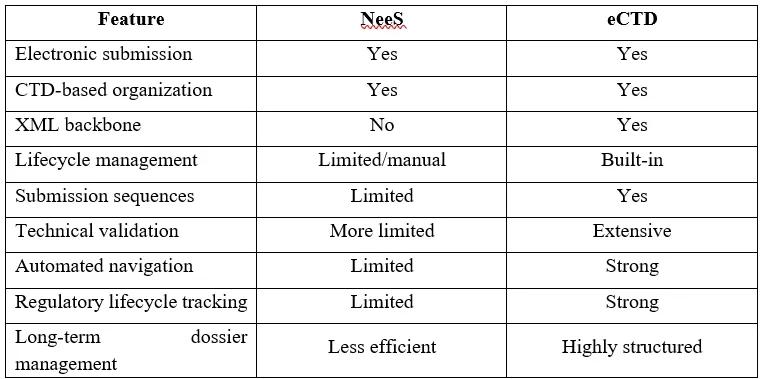
The exact acceptance and requirements for NeeS depend on the applicable regulatory authority and submission type. Therefore, the current regional requirements should always be confirmed before selecting NeeS.
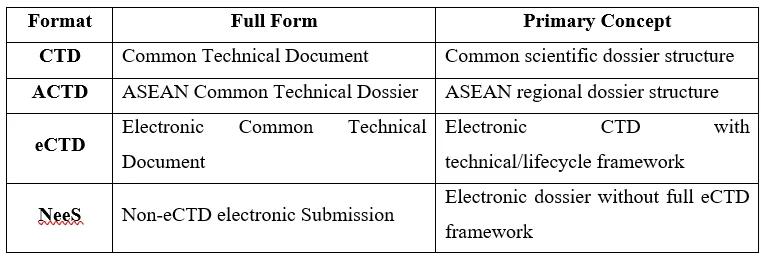
CTD vs ACTD vs eCTD vs NeeS
The easiest way to understand the four formats is:
Choosing the Right Submission Format Selecting the appropriate submission format should be based on:
1. Target Regulatory Authority
Different agencies may have different mandatory or accepted formats.
2. Product Type
The submission requirements may differ for:
- New drugs
- Generic drugs
- Biosimilars
- Biological products
- Vaccines
- Orphan products
- Investigational products
- Variations
- Post-approval submissions
3. Submission Type
The format may differ depending on whether the submission is:
- Initial application
- Amendment
- Response to deficiency
- Variation
- Supplement
- Renewal
- Post-approval change
4. Regional Requirements
A global submission strategy must account for region-specific Module 1 requirements and technical submission standards.
Why Regulatory Publishing Matters?
Preparing scientifically accurate documents is only one part of a successful submission.
A submission can also face technical problems if:
- Documents are placed in the wrong CTD section
- File names are incorrect
- Leaf titles are inconsistent
- Hyperlinks are broken
- Bookmarks are missing
- PDF files are technically non-compliant
- XML metadata are incorrect
- Lifecycle operations are incorrectly assigned
- Required regional documents are missing
- Validation errors remain unresolved
Therefore, regulatory publishing and technical validation are critical components of modern regulatory submissions.
From Dossier Authoring to Regulatory Submission - A successful electronic submission generally involves several stages:
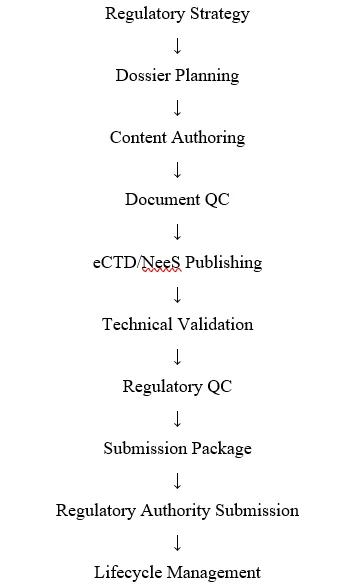
Each stage requires coordination between Regulatory Affairs, CMC, Clinical, Nonclinical, Medical Writing, Document Management, and Publishing teams.
Global Submission Strategy
For companies planning registration across multiple markets, a single global dossier strategy can improve consistency while allowing regional requirements to be incorporated.
Core Global Content
- Quality
- Nonclinical
- Clinical
Regional Content
- Administrative information
- Labelling
- Country-specific forms
- Local regulatory requirements
- Regional submission standards
This approach can reduce duplication and improve consistency across global submissions.
Common Challenges in Global Submission Publishing - Pharmaceutical companies frequently encounter challenges such as:
- Multiple Regional Formats: A global product may require CTD, ACTD, eCTD, or other regional submission approaches depending on the market.
- Document Reuse: The same scientific content may need to be adapted for different regulatory structures.
- Lifecycle Management: Post-approval changes require careful tracking of current and superseded documents.
- Technical Compliance: Electronic submissions must comply with agency-specific technical requirements.
- Regional Module 1: Administrative requirements can vary significantly between regulatory authorities.
- Submission Validation: Technical validation should be completed before transmission to identify and resolve errors.
How RegOrbis Pharma Supports Global Regulatory Submissions?
At RegOrbis Pharma, we support the complete regulatory submission lifecycle—from regulatory strategy and submission planning to CTD/ACTD dossier preparation, regional adaptation, eCTD/NeeS publishing, technical validation, submission readiness, and submission to health authorities. We also provide post-submission lifecycle management to help ensure compliant, efficient, and successful regulatory submissions across global markets.
Conclusion
Global pharmaceutical registration requires more than high-quality scientific data. The information must also be organized and presented according to the applicable regulatory submission format.
Understanding the differences between CTD, ACTD, eCTD, and NeeS enables organizations to develop more effective global submission strategies and avoid unnecessary rework during regulatory publishing.
As regulatory agencies continue to move toward structured electronic submissions, the importance of eCTD expertise, technical validation, lifecycle management, and regional submission knowledge will continue to increase.
At RegOrbis Pharma, we help organizations transform regulatory content into submission-ready dossiers aligned with global and regional regulatory expectations.
From dossier strategy to publishing and submission — RegOrbis Pharma helps you navigate global regulatory requirements with confidence.
📧 Email:Info@regorbispharma.com
📱 Phone: +91 9967265308 / 9668430491
🌐 Website:www.regorbispharma.com