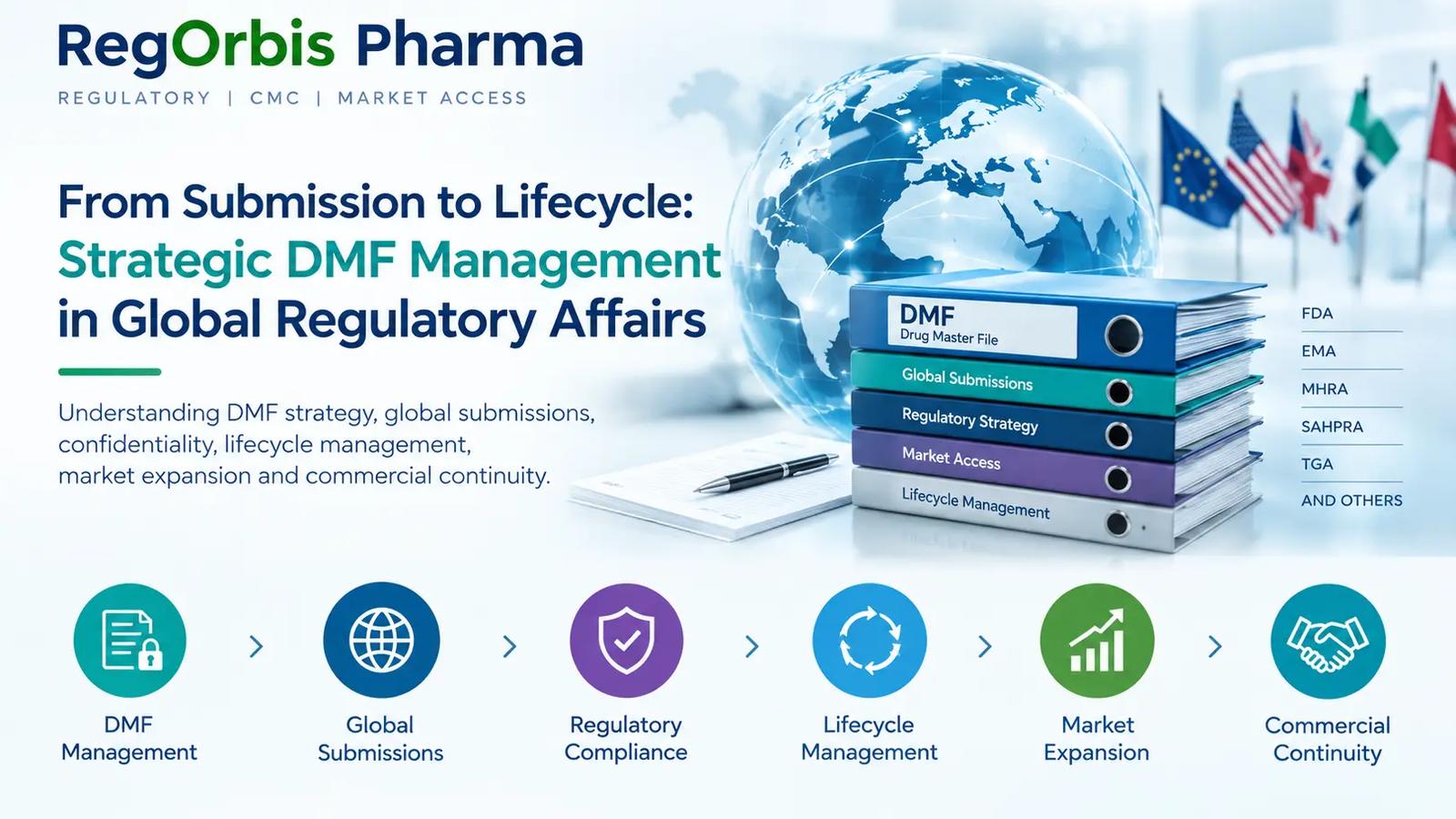
Introduction: From Regulatory Document to Strategic Asset
A Drug Master File (DMF) enables manufacturers and suppliers to submit confidential manufacturing, quality and other proprietary information directly to regulatory authorities while allowing authorized applicants to reference it in their product submissions. DMFs are commonly used for APIs, excipients, packaging materials and other specialized components.
A DMF is not a standalone marketing application and is not independently approved or rejected. Its contents are evaluated as part of the regulatory review of applications that reference it. This makes the DMF an important mechanism for protecting confidential information while enabling regulatory assessment. However, the strategic value of a DMF extends beyond its initial submission. For manufacturers and suppliers serving multiple customers, products and markets, a well-managed DMF can become a long-term regulatory and business asset supporting market access, regulatory compliance and supply continuity. Its lifecycle typically involves:
Regulatory Strategy → DMF Development → Submission → Review → Amendments → Change Management → Customer Support → Market Expansion → Lifecycle Maintenance
Understanding a Drug Master File
A Drug Master File (DMF) is a confidential regulatory submission containing detailed information needed to evaluate a drug substance, component, manufacturing process, or related material. Depending on the regulatory framework, a DMF may contain information related to:
- Drug substances (APIs) and intermediates
- Excipients and other critical materials
- Manufacturing processes and controls
- Packaging materials
- Other confidential CMC information
The primary purpose of a DMF is to protect proprietary information while providing regulatory authorities with the information necessary for scientific and regulatory assessment. The DMF creates a controlled relationship between three parties:
DMF Holder → Regulatory Authority ← Applicant/Sponsor
The applicant can reference the DMF through an appropriate authorization mechanism without receiving the complete confidential information directly.
DMF as a Business and Regulatory Asset
A well-managed DMF can provide significant commercial value to API, excipient and other material manufacturers by supporting multiple customers, products and markets through a controlled regulatory framework. From a business perspective, a DMF can help organizations:
- Support multiple customer registrations through authorized references
- Reduce repeated preparation of confidential technical information
- Accelerate customer onboarding and product registration
- Support market expansion across regulatory jurisdictions
- Maintain consistency of CMC information across submissions
- Strengthen long-term customer and supply relationships
Therefore, a DMF can function as a scalable regulatory asset that supports both market access and business growth.
Types of DMFs
DMF classification is authority-specific. One of the most commonly referenced frameworks is that of the U.S. FDA. The following classification refers specifically to the FDA framework. FDA currently identifies four active DMF types:
- Type II: Drug substance, drug substance intermediate, material used in their preparation, or drug product
- Type III: Packaging material
- Type IV: Excipient, colorant, flavor, essence, or material used in their preparation
- Type V: FDA-accepted reference information
FDA's current information confirms these four active categories. Type I was discontinued in 2000, while the numbering of the remaining types was retained.
Type II DMF
Type II is particularly important for pharmaceutical manufacturers and API suppliers. It can cover:
- Drug substances
- Drug substance intermediates
- Materials used in their preparation
- Certain drug product information
For an API manufacturer, the Type II DMF can become a major regulatory asset because the same API may support multiple finished-product applications. This creates an important business relationship:
One API → Multiple Customers → Multiple Products → Multiple Regulatory Applications
Consequently, the quality and lifecycle management of the Type II DMF can directly influence the manufacturer's ability to support customers and expand into additional markets. FDA also has specific completeness-assessment and GDUFA-related processes for certain Type II API DMFs supporting ANDAs.
Type III DMF
Type III relates to packaging materials. Packaging information can include:
- Identification of the packaging material
- Components
- Composition
- Manufacturing information
- Release specifications
- Testing
- Supporting information regarding suitability for intended use
Type IV DMF
Type IV is associated with:
- Excipients
- Colorants
- Flavors
- Essences
- Materials used in their preparation
The information can include:
- Manufacturing process
- Characterization
- Release specifications
- Testing methods
- Safety-related information
- Supporting data
For excipient manufacturers, a Type IV DMF can become an important part of their customer-support and market-access strategy. Regulatory readiness can become a differentiator when pharmaceutical customers are selecting suppliers for regulated markets.
Type V DMF
Type V covers FDA-accepted reference information. It is not intended simply as a repository for miscellaneous or duplicate information. FDA's guidance indicates that a holder wishing to submit information outside Types I–IV should first communicate its intent to the agency. Therefore, Type V should be approached strategically rather than used as a general-purpose storage mechanism.
Historical Type I
Historically, Type I related to:
- Manufacturing site
- Facilities
- Operating procedures
- Personnel
FDA discontinued Type I DMFs in 2000. The remaining types retained their numbering. This is important because older regulatory literature may still refer to Type I, while current FDA classification does not include it as an active DMF category.
DMF Classification Is Not Universal
A DMF or master file is not a globally standardized regulatory mechanism. Terminology, content requirements, submission procedures, reference mechanisms, and lifecycle expectations can differ depending on the applicable regulatory framework. Different authorities may use mechanisms such as DMF, Master File, Active Substance Master File (ASMF), Applicant/Open Part, or Restricted/Confidential Part. For pharmaceutical companies planning international expansion, this means that a DMF developed for one market may not be directly transferable to another. Organizations should assess the requirements of each target market early in the regulatory planning process, including the applicable master file mechanism, submission format, reference process, and lifecycle requirements. Early regulatory gap assessment can help identify market-specific requirements, minimize rework, support efficient customer registrations, and improve overall market-entry readiness.
DMF Holder, Applicant and Regulatory Authority
A DMF involves three primary stakeholders, each with a defined regulatory and commercial role:
- DMF Holder: Owns or controls the confidential information and manages its submission, maintenance and updates.
- Applicant/Sponsor: Uses an authorized reference to support its product registration and regulatory submissions.
- Regulatory Authority: Reviews the relevant DMF information as part of the associated regulatory application.
The relationship can be summarized as:
DMF Holder → Regulatory Authority ← Applicant/Sponsor
Effective coordination among these stakeholders is essential for regulatory compliance, timely submissions, customer support and continuity of the DMF throughout its lifecycle.
Letter of Authorization and Reference Strategy
A DMF creates greater strategic value when it is effectively linked to the applications and customers that reference it. The key relationship can be managed as:
DMF → Authorization → Customer → Product → Application → Market
When multiple customers rely on the same DMF, effective reference tracking becomes critical because a DMF change may impact multiple products, customers and markets. Therefore, DMF referencing should be integrated with customer management, regulatory tracking, change control and lifecycle management rather than treated as a purely administrative activity.
DMF Content and CMC Foundation
The technical foundation of a DMF is its Chemistry, Manufacturing and Controls (CMC) information. For drug substances, the content generally aligns with the relevant CTD Quality sections:
- 3.2.S.1 General Information: Nomenclature, structure and general properties.
- 3.2.S.2 Manufacture: Manufacturer details, manufacturing process, process controls, critical steps, validation/evaluation and process development.
- 3.2.S.3 Characterization: Structure elucidation, impurities and other relevant characterization information.
- 3.2.S.4 Control of Drug Substance: Specifications, analytical procedures, validation, batch analysis and justification of specifications.
- 3.2.S.5 Reference Standards or Materials: Reference standard information and qualification.
- 3.2.S.6 Container Closure System: Packaging system and suitability considerations.
- 3.2.S.7 Stability: Stability studies, protocols, results and proposed retest period/storage conditions, where applicable.
The exact content and organization should be aligned with the applicable authority, product and regulatory pathway. Importantly, the CMC package should be designed with the intended applications, customers and future lifecycle changes in mind to minimize regulatory rework.
DMF and CTD Module 3
The DMF and CTD Module 3 are closely connected because confidential CMC information in the DMF may support the corresponding information in the applicant's CTD Module 3.2.S. For example, DMF information on manufacturing, specifications, analytical procedures, impurity controls, packaging and stability may support the respective sections of the applicant's dossier. Therefore, the DMF and applicant dossier should remain scientifically and administratively aligned. Differences in manufacturing sites, specifications, processes, analytical methods, retest periods, packaging or document versions may lead to regulatory queries. This makes DMF lifecycle management an important component of dossier lifecycle management, particularly when multiple products or customers reference the same DMF.
Global DMF Strategy
A global DMF strategy should distinguish between a common scientific core and a market-specific regulatory layer. The fundamental technical and scientific information should remain controlled, consistent, and standardized across markets, while recognizing that different regulatory authorities may require variations in administrative information, submission structures, formats, reference mechanisms, lifecycle procedures, updates, and communication processes. Therefore, having one common technical core does not necessarily mean having one identical global submission. Instead, the strategy should follow a “Common Technical Core + Market-Specific Regulatory Requirements” approach, which can help reduce duplication while preserving the regulatory flexibility needed to meet the specific requirements of each market.
DMF Strategy for Market Entry
A company's decision to enter a new market should consider DMF readiness as part of regulatory planning.
Commercial Opportunity Identified→ Target Market Selected→ Authority Requirements Assessed→ Existing DMF Gap Assessment→ Technical/Regulatory Gap Closure→ DMF Preparation or Update→ Customer/Application Strategy→ Submission
This connects regulatory affairs directly with commercial planning. A company may have a commercially attractive market opportunity, but if its DMF is not aligned with the target authority's expectations, regulatory preparation can delay the opportunity. Therefore, DMF readiness can become part of market-entry readiness.
DMF Submission and Regulatory Review
Submission is not the end of the DMF process. Regulatory authorities may evaluate the administrative and technical content, including manufacturing processes, specifications, analytical procedures, impurity controls, stability, packaging, supporting data and cross-references. Questions or deficiencies may arise during review, requiring a structured process of:
Submission → Review → Questions → Response → Amendment → Closure of Issue
Maintaining clear traceability between the original DMF information and subsequent responses is essential, particularly when the same DMF supports multiple customers and applications.
13. Deficiency and Regulatory Query Management
A DMF deficiency is not merely a regulatory event. It can potentially become a business event.
DMF Deficiency→ Regulatory Response Required→ Customer Application Impact→ Potential Submission Delay→ Potential Product Launch Impact
Therefore, deficiency management should be performed with both regulatory and commercial awareness.
DMF Lifecycle and Change Management
A DMF should be treated as a continuously managed regulatory asset rather than a one-time submission. Its lifecycle involves planning the regulatory and market strategy, preparing and submitting the DMF, managing references and regulatory reviews, maintaining current information, assessing CMC changes, submitting updates or amendments, and expanding support to additional customers and markets. Change management is a core component of this lifecycle, as changes may be administrative, such as DMF holder details, address, ownership, or DMF title, or technical, involving manufacturing processes or sites, specifications, analytical procedures, packaging, stability, or control strategies. The regulatory significance of each change may vary depending on the applicable regulatory framework, product, and market. Therefore, each change should be assessed systematically across four dimensions:
Technical Impact → Regulatory Impact → Customer Impact → Market Impact.
This assessment should determine the affected DMF sections, required regulatory actions, potentially impacted customers and applications, and the need for additional supporting data or customer communication. A structured lifecycle and change management approach helps maintain regulatory compliance, ensure effective customer support, reduce rework, minimize submission and supply disruptions, and preserve the long-term regulatory and commercial value of the DMF.
Multi-Customer DMF Management
A well-managed DMF can support multiple customers, products and markets, making it a scalable regulatory and commercial asset. For example, one DMF may support 10 customers across 5 countries and 15 products. A single CMC change could therefore affect multiple applications and regulatory commitments. Effective lifecycle management should maintain the relationship:
DMF → Version → Change → Customer → Product → Market → Submission → Regulatory Action
This visibility enables organizations to quickly identify affected customers and markets, assess regulatory impact and coordinate required actions. As the number of references grows, spreadsheets and disconnected folders become increasingly difficult to manage, creating a strong need for structured DMF lifecycle and relationship management.
Regulatory Readiness as Customer Value
Regulatory readiness can be a strong differentiator for API and material suppliers. Customers increasingly value DMF availability, target-market support, quality documentation, change-control capability, regulatory responsiveness, and lifecycle support when selecting suppliers. Strong regulatory capabilities can therefore drive customer acquisition, retention, and long-term partnerships. The value proposition can evolve from “We supply an API” to “We supply an API supported by a regulatory strategy for your target markets.” This positions the DMF not just as a compliance requirement, but as a strategic business asset that strengthens customer confidence and market competitiveness.
Regulatory Impact Assessment
A structured DMF impact assessment can be performed whenever a significant regulatory or technical change occurs. A practical assessment model can include:
- Technical: What has changed?
- CMC: Which technical sections are affected?
- Regulatory: What authority action is required?
- Customer: Which customers reference the affected information?
- Product: Which products are affected?
- Market: Which countries are affected?
- Submission: Which applications require updates?
- Commercial: Could the change affect supply or launch timelines?
- Communication: Who needs to be informed?
- Lifecycle: What future updates are required?
This provides a bridge between CMC change control and commercial decision-making.
DMF and Commercial Continuity
Regulatory compliance and commercial continuity are closely connected. A regulatory change that is not appropriately managed can potentially result in:
- Submission delays
- Additional authority questions
- Customer uncertainty
- Rework
- Delayed product launches
- Supply disruption
- Increased regulatory costs
Conversely, effective lifecycle management can support:
- Faster regulatory response
- Better customer communication
- Consistent technical information
- Better market readiness
- Reduced duplication
- Improved confidence in regulatory operations
Therefore, Regulatory Lifecycle Management → Commercial Continuity
This is one of the most important strategic reasons to move beyond a document-centric approach to DMF management.
Digital DMF Lifecycle Management
As DMF portfolios grow, organizations need structured digital systems to manage documents, versions, metadata, customers, products, markets, submissions, changes, and regulatory history. The goal is to move beyond document storage by establishing clear relationships across DMF → Version → Customer → Product → Market → Submission → Change → Regulatory Action. This enables organizations to quickly identify which DMF version was referenced, for whom and where it was used, and what changes have occurred since submission. The key shift is from “Where is the document?” to “What is the regulatory and business impact of the document?”—moving from document management to true regulatory lifecycle management.
DMF Integration with Regulatory Information Management
For organizations managing large regulatory portfolios, DMF data can be integrated into a broader Regulatory Information Management System (RIMS), connecting:
Product → Market → Application → DMF → Customer → Submission → Sequence → Change/Variation → Regulatory Commitment → Approval → Lifecycle Event
This provides a consolidated view of the product's regulatory history and lifecycle status. For consulting organizations and regulatory service providers, such integration can improve project visibility, customer reporting, submission tracking and overall regulatory portfolio management.
DMF Management and Electronic Submissions
DMF management is closely connected with electronic submissions, particularly where regulatory authorities require structured electronic formats. DMF-related information may need to be authored, structured, published, validated, submitted, and maintained throughout its lifecycle, creating a process from:
Document Authoring → CTD/eCTD Structure → publishing → Validation → Submission → Regulatory Review → Subsequent Sequence → Lifecycle Update
Effective DMF management therefore requires control over document granularity, metadata, versioning, references, hyperlinks, sequence structure, validation, submission history, and change control. When technical changes occur, their regulatory and business impact should be assessed across affected products, applications, customers, and markets. This requires cross-functional governance involving Regulatory Affairs, CMC/Technical, Quality, Regulatory Operations, and Commercial teams. Clear ownership, controlled content, change assessment, submission planning, regulatory intelligence, and customer communication help maintain an accurate and compliant DMF throughout its lifecycle. Ultimately, DMF governance should connect:
DMF → Product → Market → Application → Customer → Submission → Change → Regulatory Commitment → Approval → Lifecycle Event
Transforming DMF management from document control into strategic regulatory lifecycle management.
DMF as a Business Strategy
The strategic value of a DMF can be summarized through five business dimensions.
- Customer Acquisition: Regulatory readiness can strengthen the ability to support new pharmaceutical customers.
- Customer Retention: Consistent lifecycle support can strengthen long-term customer relationships.
- Market Expansion: A scalable DMF strategy can support entry into additional countries.
- Operational Efficiency: Centralized information can reduce repeated preparation and rework.
- Commercial Continuity: Effective lifecycle management can help maintain regulatory readiness after initial approval.
Therefore, the DMF can contribute to both regulatory performance and business scalability.
From Submission Strategy to Market Strategy
Traditional thinking often views the process as:
Prepare DMF → Submit DMF → Wait for Review
A strategic approach is broader:
Business Opportunity→ Target Market→ Regulatory Requirements→ DMF Gap Assessment→ CMC Strategy→ DMF Preparation→ Customer/Application Strategy→ Submission→ Regulatory Review→ Lifecycle Management→ Market Expansion
This model connects regulatory affairs directly with business objectives.
The Future of DMF Management
The future of DMF management is expected to become more digital, lifecycle-oriented, data-driven, multi-market, customer-centric, and integrated with regulatory systems. Organizations will increasingly move from simple document storage toward structured regulatory information and integrated regulatory lifecycle management. In this model, the DMF becomes a structured regulatory asset linking products, customers, markets, documents, submissions, changes, and regulatory decisions, enabling greater visibility and better regulatory and business decisions.
Conclusion
A DMF should not be viewed as a static technical package prepared only for an initial submission. It is a confidential regulatory asset that can support multiple products, customers, markets, and lifecycle activities. Its strategic value lies in effective submission management, referencing, regulatory review, change control, lifecycle maintenance, customer support, market expansion, and regulatory intelligence. Therefore, DMF strategy should align regulatory requirements with broader business and commercial objectives. The key shift is from submission readiness to lifecycle readiness—where a submission-ready DMF meets today’s regulatory needs, while a lifecycle-ready DMF supports future market opportunities, regulatory requirements, and long-term business growth.
How RegOrbis Pharma supports clients
RegOrbis Pharma supports pharmaceutical organizations by providing end-to-end regulatory expertise across strategy, global registrations, dossier and DMF management, CMC regulatory support, lifecycle management, regulatory intelligence, and strategic advisory. We help organizations navigate complex regulatory requirements, maintain compliant and submission-ready documentation, manage regulatory changes, and support market expansion. By connecting regulatory strategy with business objectives, RegOrbis Pharma enables clients to achieve efficient market entry, maintain regulatory continuity, and support long-term business growth. This article is intended for general informational purposes and does not constitute regulatory or legal advice. Specific DMF requirements should be assessed against the applicable regulatory framework and current authority guidance.
📧 Email:Info@regorbispharma.com
📱 Phone: +91 9967265308 / 9668430491
🌐 Website:www.regorbispharma.com