Introduction
South Africa is an important pharmaceutical market for companies seeking to expand their presence in South Africa. However, successful market entry requires more than preparing a technically complete registration dossier. Companies should evaluate the regulatory pathway, product opportunity, manufacturing readiness, local representation, market access, commercial launch and post-approval requirements as part of an integrated market-entry strategy. The South African Health Products Regulatory Authority (SAHPRA) regulates medicines and other health products in South Africa. For human medicines, applications are assessed against applicable requirements for quality, safety, efficacy, manufacturing, product information and administrative compliance. This article provides a practical overview of SAHPRA registration and the key regulatory and business considerations for pharmaceutical companies planning to enter the South African market.
1. Why South Africa Matters for Pharmaceutical Market Entry?
Before beginning registration, companies should assess the commercial opportunity alongside regulatory requirements.
Key considerations include:
- Product and therapeutic-area opportunity
- Product differentiation
- Target market
- Regulatory pathway
- Manufacturing and supply strategy
- Local representation
- Pricing and market access
- Commercial launch plans
The objective is to determine whether the regulatory investment and commercial opportunity are aligned.
2. South Africa Market-Entry Strategy
A practical market-entry strategy can be viewed as:
Market Assessment → Product Assessment → Regulatory Strategy → Registration → Market Access → Launch → Lifecycle Management
Companies should assess:
- Is there a viable market opportunity?
- What competitors are already present?
- What registration pathway applies?
- Can an existing global dossier be adapted?
- Is reliance potentially applicable?
- What local representation is required?
- How will the product be priced, supplied and distributed?
This helps ensure that regulatory planning supports the broader business strategy.
3. Understanding SAHPRA
The South African Health Products Regulatory Authority (SAHPRA) is responsible for regulating medicines and other health products in South Africa. For human medicines, key areas of assessment include:
- Administrative and regulatory compliance
- Product information and labelling
- Quality
- Safety
- Efficacy
Applicants should always verify the latest applicable SAHPRA guidelines, forms and templates before preparing a submission.
4. Types of Human Medicine Applications
SAHPRA requirements depend on the nature of the product and application. Applications may include:
- New medicine applications
- Generic or multisource medicine applications
- Biological medicine applications
- Line extensions and other applicable applications
The regulatory strategy should therefore be established before dossier preparation:
Product → Classification → Pathway → Data Requirements → Submission Format
5. SAHPRA Registration Pathways
SAHPRA has different evaluation approaches, including:
- Full review
- Abridged review
- Verified review
- Reliance-based approaches, where applicable
The appropriate pathway depends on the application type, available regulatory information and applicable SAHPRA requirements. Pathway selection should be considered early because it can influence dossier requirements, regulatory planning and overall market-entry strategy.
6. Regulatory Reliance
Reliance can be an important consideration for companies with existing regulatory approvals or assessment information from other jurisdictions.
SAHPRA's current Reliance Guideline, SAHPGL-BAU-01, Version 7, provides recommendations for reliance-based evaluation of applicable new registration applications and variations. Companies should assess:
- Reliance eligibility
- Recognized Regulatory Authority applicability
- Availability of assessment reports
- Required declarations and forms
- Additional SAHPRA requirements
Reliance should not be assumed automatically; eligibility should be assessed against the current SAHPRA requirements.
7. SAHPRA Registration Dossier – CTD Structure
SAHPRA medicine registration applications are generally structured according to the Common Technical Document (CTD) format, consisting of five modules:
Module 1 – Regional / Administrative Information: Contains South Africa-specific information required by SAHPRA, including application details, administrative documents, product information, labelling and other regional requirements.
Module 2 – CTD Summaries: Provides summaries and overviews of the Quality, Nonclinical and Clinical information presented in Modules 3, 4 and 5.
Module 3 – Quality / CMC: Contains information demonstrating the quality of the medicine, including the drug substance, drug product, manufacturing process, specifications, analytical methods, validation and stability.
Module 4 – Nonclinical: Contains nonclinical safety information, including pharmacology, pharmacokinetics and toxicology, as applicable.
Module 5 – Clinical: Contains clinical evidence supporting the safety and efficacy of the medicine, including clinical studies and bioequivalence data where applicable.
A successful submission requires consistency across all five modules, particularly between the technical dossier, product information, manufacturing details and administrative documents. For electronic submissions, the dossier should also meet applicable SAHPRA eCTD technical and regional Module 1 requirements.
8. 2026 Screening Checklist – Submission Readiness
The SAHPRA Screening Checklist for New Medicine Applications is an important current submission-readiness requirement. For applicable dossiers submitted from 1 April 2026, the Screening Checklist replaced the previous Screening Report. Before submission, companies should verify:
- Administrative completeness
- Required documents
- Hyperlinks
- Dossier structure
- Product information
- Application forms
- Applicable technical requirements
The objective is to identify potential deficiencies before submission rather than during screening.
9. GMP and Manufacturing-Site Readiness
Manufacturing-site readiness is an important part of regulatory and market-entry planning. Companies should assess:
- GMP certification
- Manufacturing license
- Site Master File
- Manufacturing-site information
- Inspection history
- Quality systems
- Supporting regulatory documentation
Manufacturing readiness should be evaluated early to reduce potential regulatory and supply risks.
10. Local Representation and Commercial Coordination
Depending on the product and business model, companies may need to coordinate with:
- Marketing Authorization Holder
- Manufacturer
- Regulatory consultant
- Local representative or partner
- Importer/distributor
- Supply-chain partners
- Pharmacovigilance functions
Clear allocation of responsibilities can improve regulatory communication and commercial readiness.
11. Pricing, Reimbursement and Market Access
Regulatory approval is an important milestone, but it does not by itself guarantee commercial success. Companies should consider:
- Product positioning
- Competitive pricing
- Reimbursement environment
- Public and private market opportunities
- Tender opportunities, where applicable
- Distribution strategy
- Supply-chain costs
- Commercial launch plans
Regulatory strategy should therefore be aligned with the company's overall market-access strategy.
12. Labelling, Artwork and Product Information
Companies should ensure consistency across:
- Product name
- Active ingredient and strength
- Dosage form
- Indications and posology
- Warnings and precautions
- Storage conditions
- Manufacturer and MAH information
- Professional Information
- Patient Information Leaflet
- Labels and artwork
Product information should remain consistent with the scientific dossier and applicable SAHPRA requirements.
13. Regulatory Investment and Resource Planning
Before initiating registration, companies should assess the resources required for:
- Regulatory strategy
- Gap assessment
- Dossier preparation
- CMC remediation
- Local representation
- Regulatory fees
- eCTD publishing and validation
- Artwork and labelling
- Regulatory responses
- Post-approval maintenance
Early planning can help identify gaps and improve project predictability.
14. Common SAHPRA Registration & Market-Entry Challenges
Administrative Gaps: Missing information, incorrect forms or inconsistent documentation.
CMC Inconsistencies: Differences in manufacturing information, specifications, batch data or stability information.
Dossier Inconsistency: Differences between CTD/eCTD sections, Module 1, product information, labels and certificates.
eCTD Technical Errors: Incorrect document placement, broken hyperlinks, missing bookmarks, incorrect metadata or validation failures.
Outdated Requirements: Failure to use the latest SAHPRA guidelines, forms and templates.
Commercial Readiness Gaps: Insufficient competitor assessment, unclear pricing strategy, incomplete distribution planning or lack of launch readiness.
15. Practical SAHPRA Registration Workflow
A practical SAHPRA registration workflow can be summarized as:
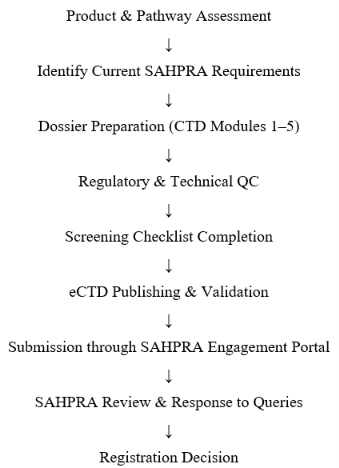
This structured workflow helps companies maintain regulatory compliance, submission readiness and effective dossier management throughout the registration process.
16. Beyond Registration: Lifecycle Management
Registration should not be considered the end of the regulatory project. Post-approval activities may include:
- Renewals
- Variations
- Manufacturing-site changes
- Product information updates
- Labelling changes
- Safety-related updates
- Pharmacovigilance
- Regulatory commitments
- Product complaints and recalls
- New indications
- Product extensions
- Regulatory intelligence
A strong strategy therefore considers:
Registration → Launch → Maintenance → Expansion → Lifecycle Management
17. How RegOrbis Pharma Can Support South Africa Market Entry
RegOrbis Pharma supports pharmaceutical and life-science companies with regulatory and market-entry activities, including:
- Regulatory Strategy & Pathway Assessment
- South Africa Market-Entry Strategy
- SAHPRA Registration Support
- CTD/eCTD Dossier Preparation & Management
- CMC & DMF Support
- Regulatory Gap Assessment
- Labelling & Artwork Compliance
- eCTD Publishing & Technical QC
- Submission Readiness
- Regulatory Query Management
- Post-Approval Lifecycle Management
Our approach integrates regulatory requirements with practical market-entry considerations, helping companies identify gaps, improve submission readiness and plan for sustainable market access.
Conclusion
Successful pharmaceutical market entry in South Africa requires an integrated approach combining:
Market Opportunity + Regulatory Strategy + CTD/eCTD Readiness + CMC + GMP + Local Representation + Market Access + Commercial Launch + Lifecycle Management Companies should therefore evaluate the commercial opportunity and regulatory pathway before investing in dossier preparation. Ultimately, South African market entry is not simply a registration exercise—it is a coordinated regulatory and business strategy.
At RegOrbis Pharma, we support pharmaceutical companies from regulatory strategy and dossier preparation through SAHPRA submission readiness, regulatory support and post-approval lifecycle management.
From Regulatory Strategy to Market Entry — Navigating Regulations and Delivering Trust.
📧 Email: Info@regorbispharma.com
📱 Phone: +91 9967265308 / 9668430491
🌐 Website: www.regorbispharma.com